01Requirement Studio
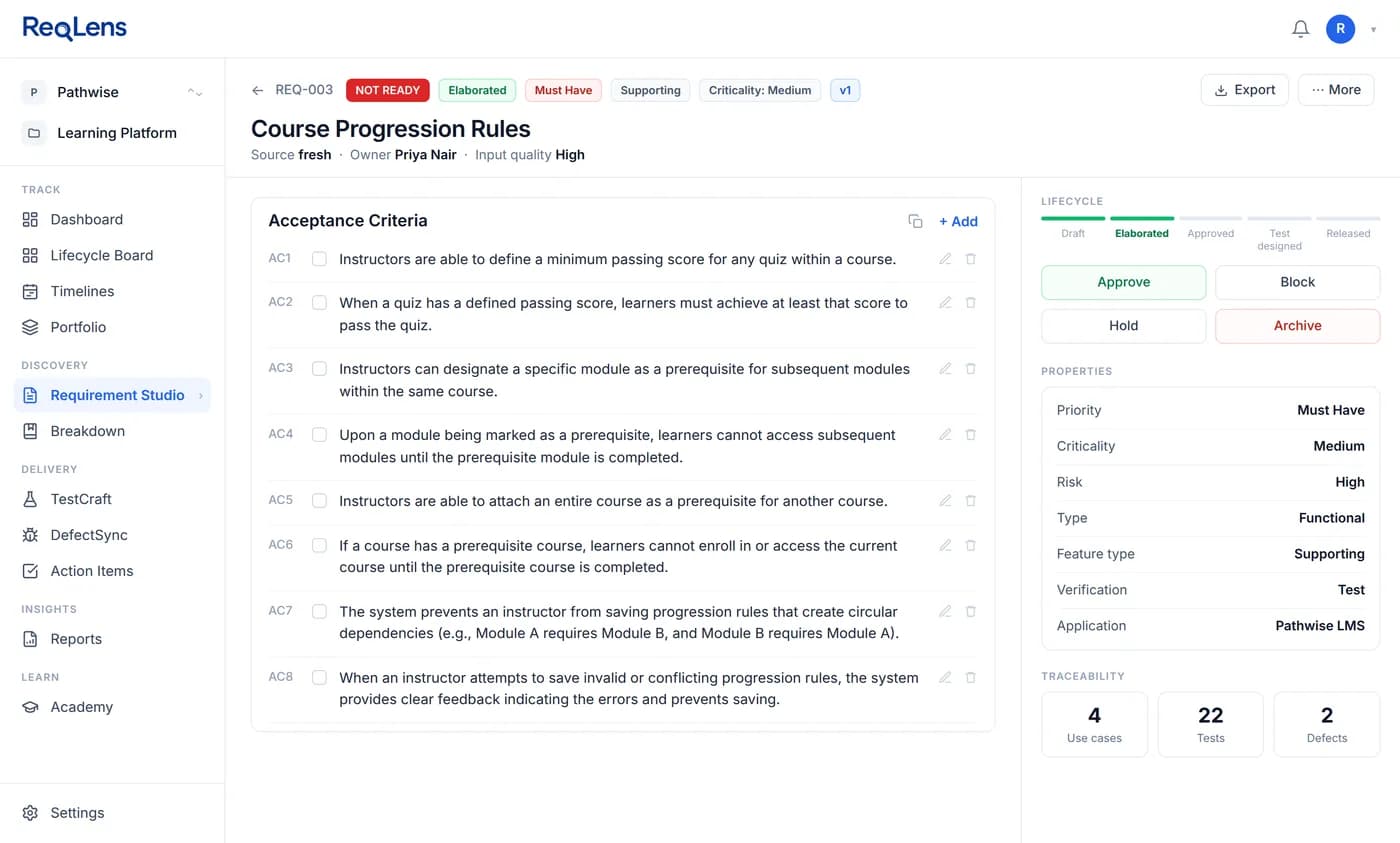
Paste it in. Get a structured artifact back.
One paragraph of intent becomes background, business value, actors and numbered acceptance criteria a developer can build against and a tester can verify. This is acceptance criteria generation as a reviewable artifact rather than a chat response: you edit any line inline, reorder it, delete what does not apply, and every version is kept with a diff against the last one. Requirements written this way are testable by construction, which is what makes every downstream stage possible.
02Readiness verdict
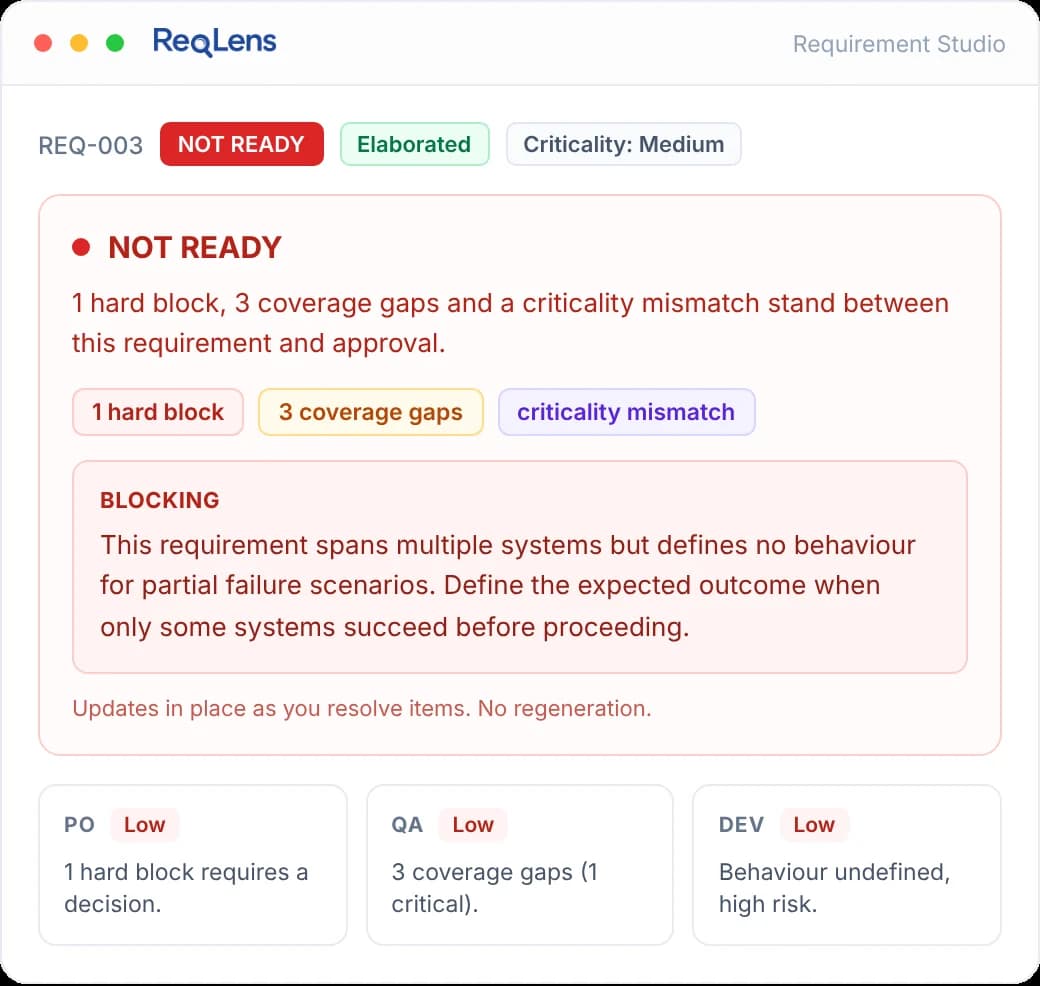
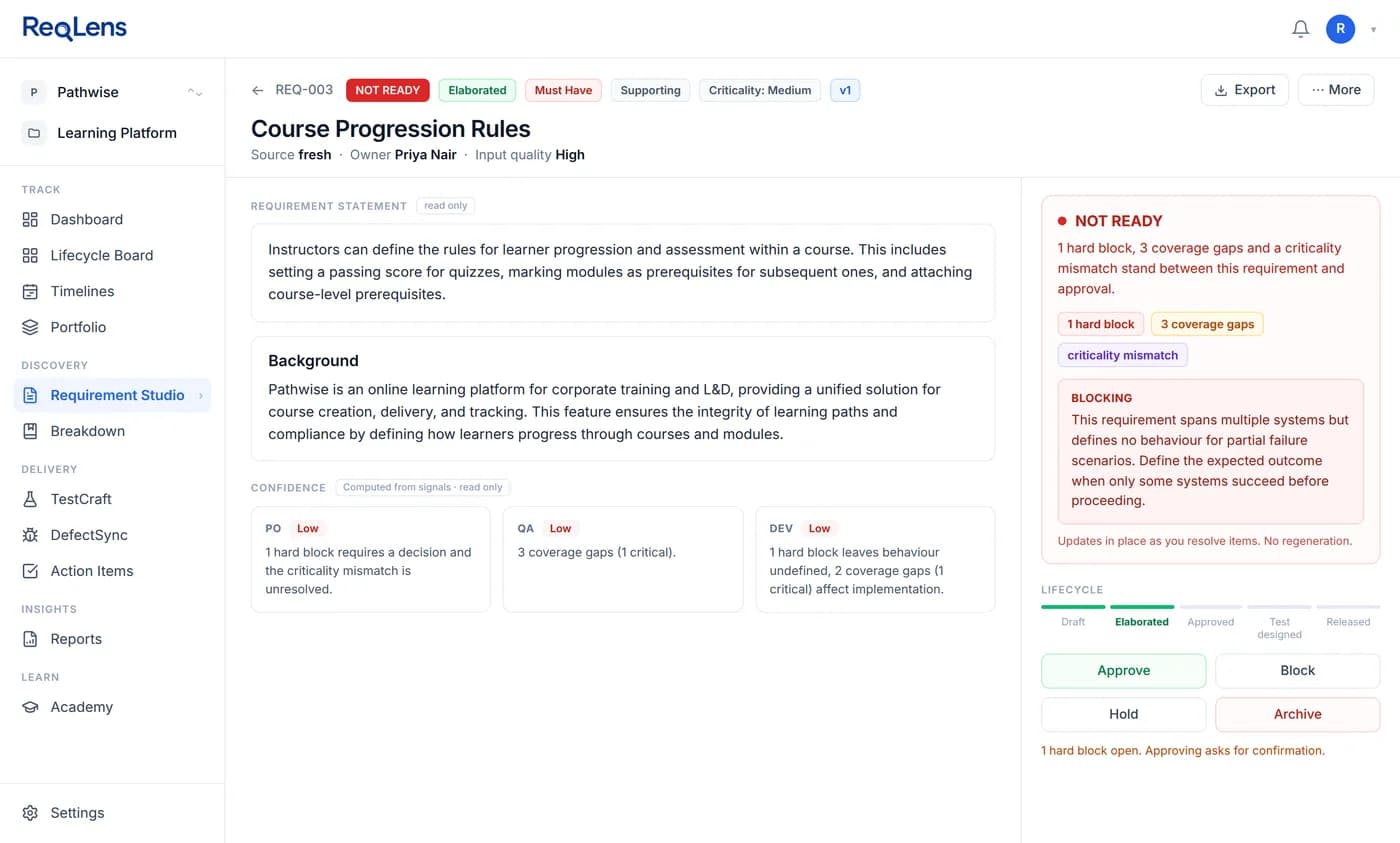
ReqLens refuses to call it ready, and says why.
This is the part no test management tool does. ReqLens grades requirement readiness and names each blocker in the language of the requirement itself: the failure behaviour left undefined, the business rule stated but never specified, the observability nobody asked for, the criticality that does not match the risk signals in the text. It then splits confidence three ways, so a product owner, a QA engineer and a developer each see their own exposure rather than one blended score nobody owns.
- 1 hard block
- 3 coverage gaps
- criticality mismatch
- PO confidence: low
- QA confidence: low
- DEV confidence: low
03Gaps and Action Items
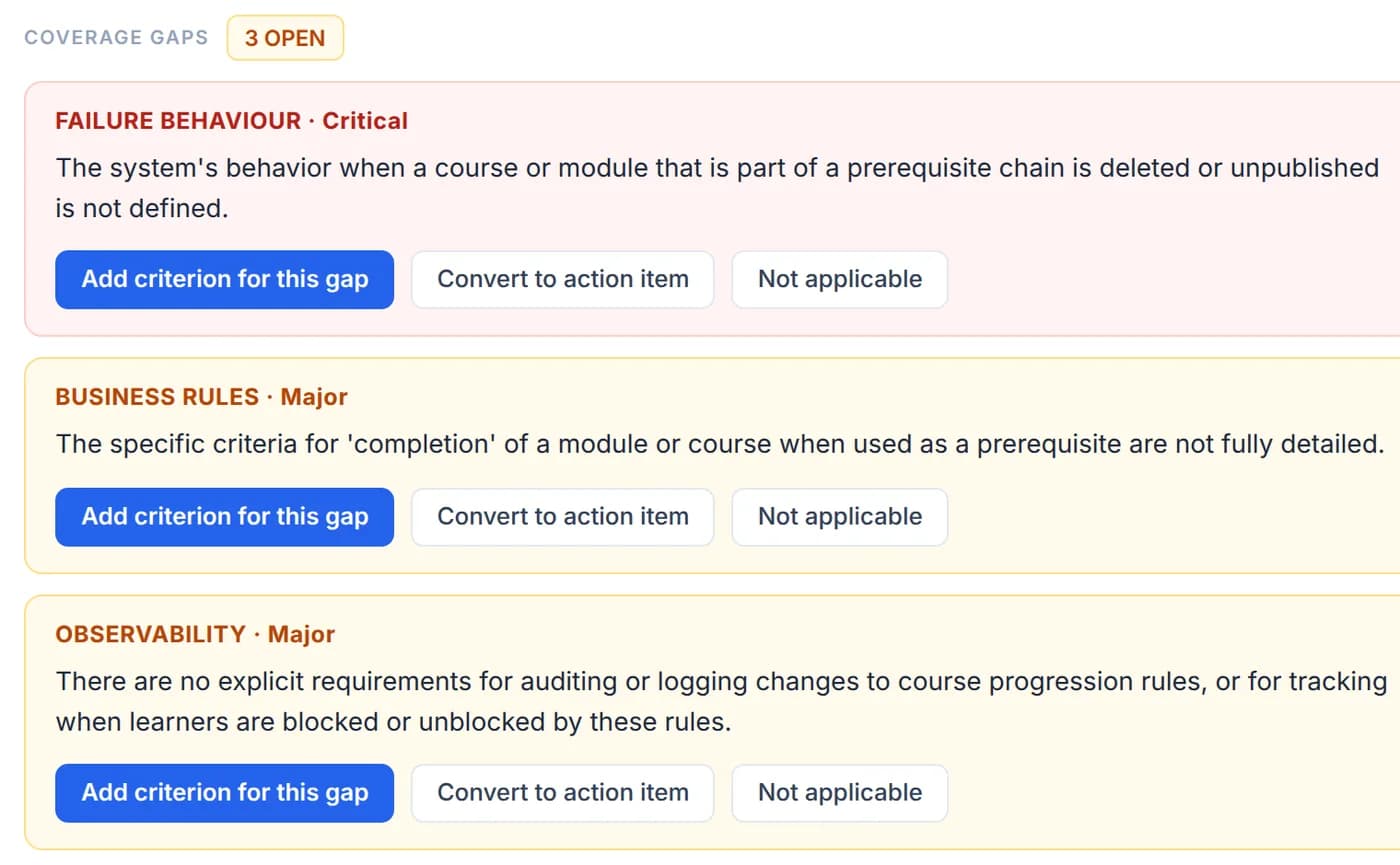
Every gap has a next action, not just a warning.
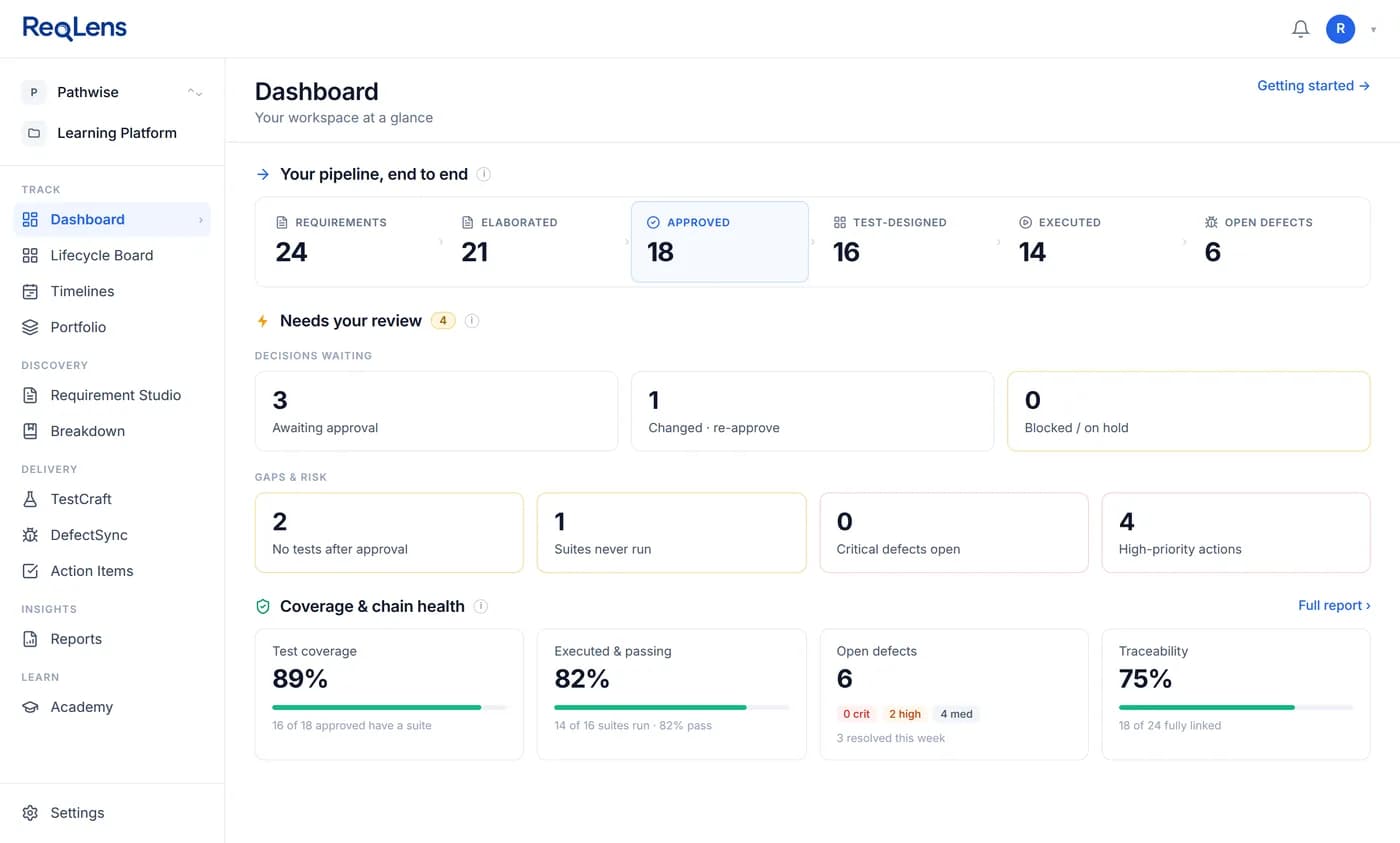
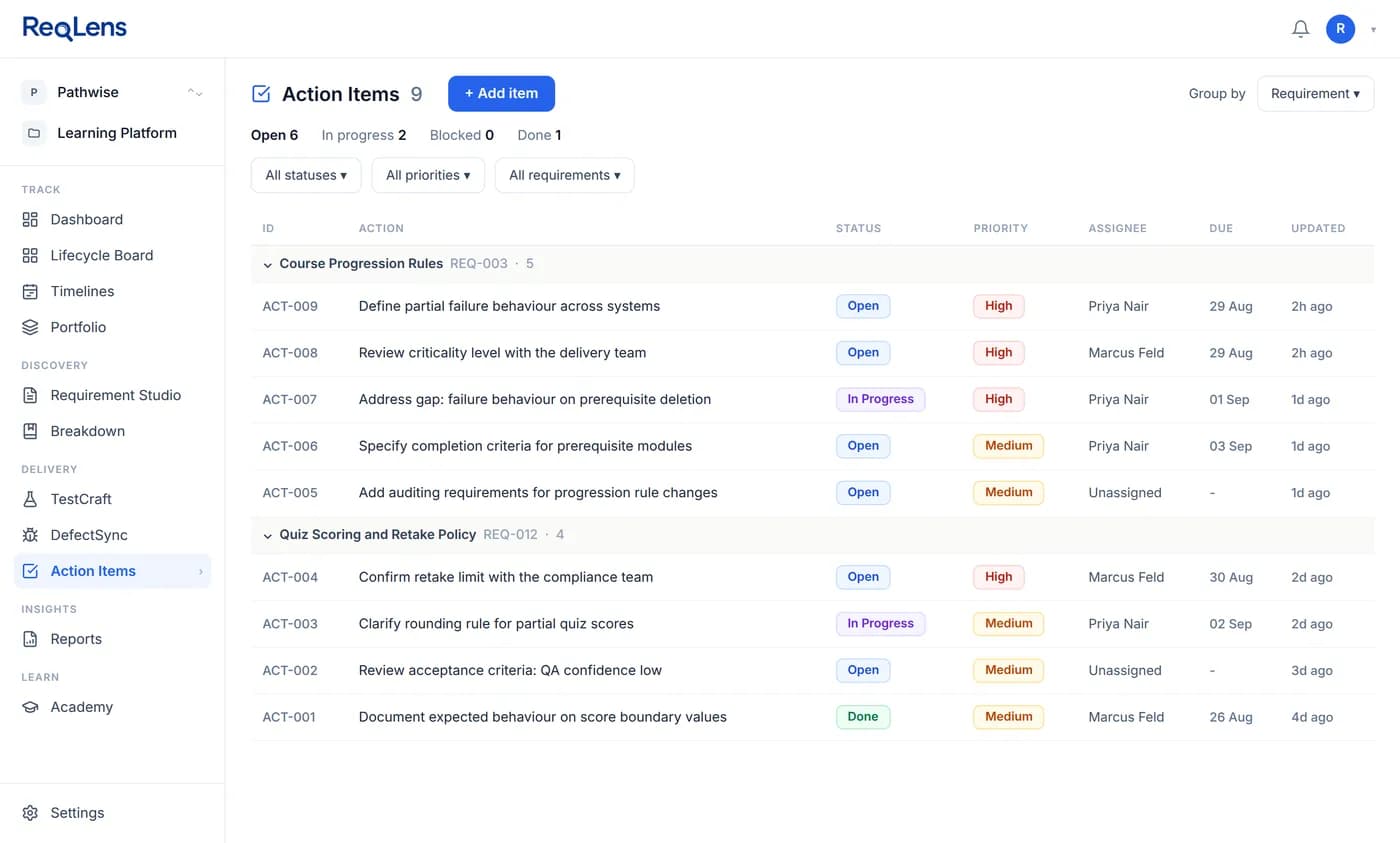
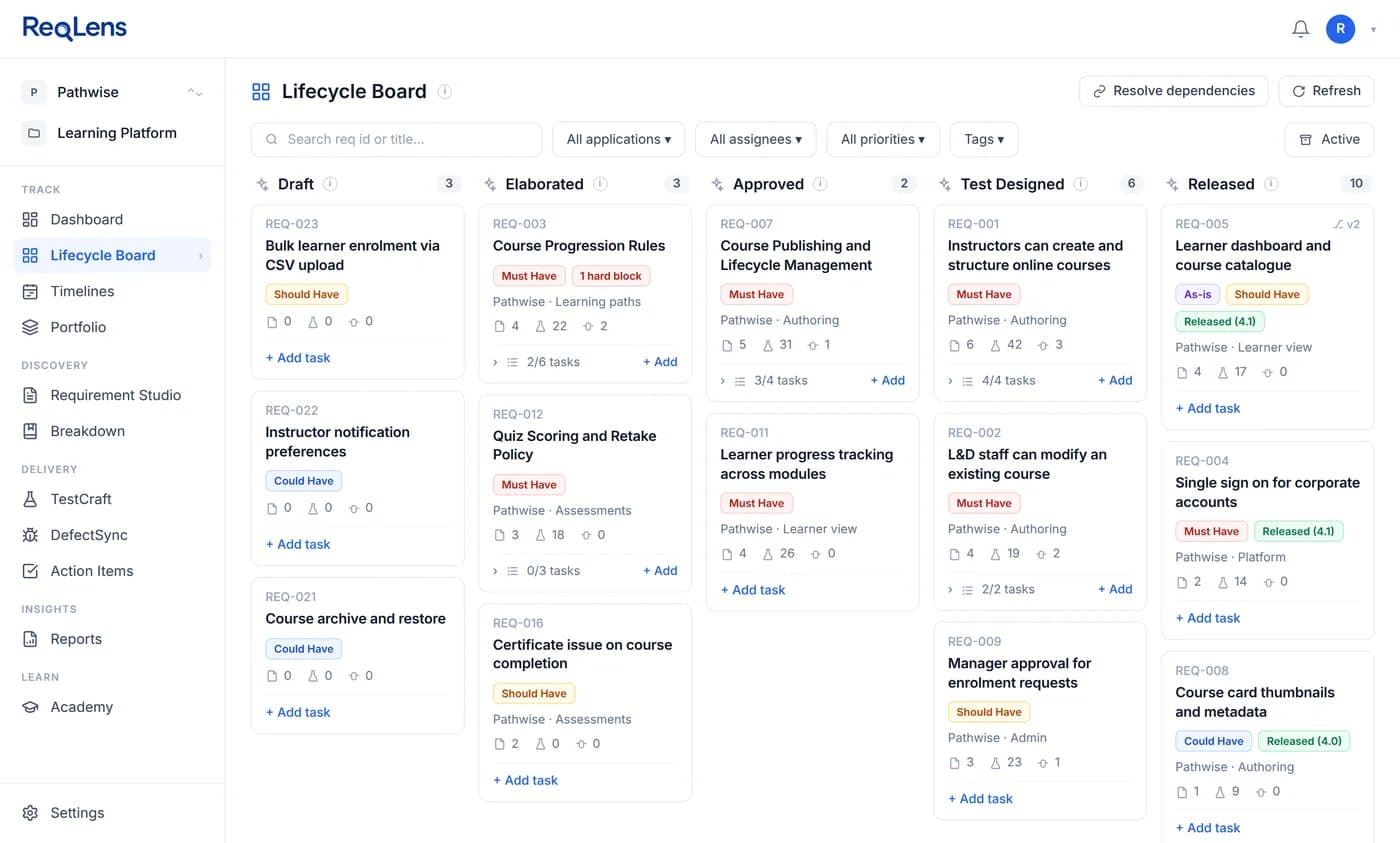
Add a criterion to close the gap, convert it into a tracked action item owned by someone else, or mark it not applicable with a reason. Resolving updates the readiness verdict in place: nothing regenerates, nothing you wrote is overwritten, and the audit trail keeps who decided what. A gap that becomes an action item stays visible on the board until it is closed, so requirement debt cannot quietly age out of view.
04TestCraft
Approve it, and the test suite writes itself.
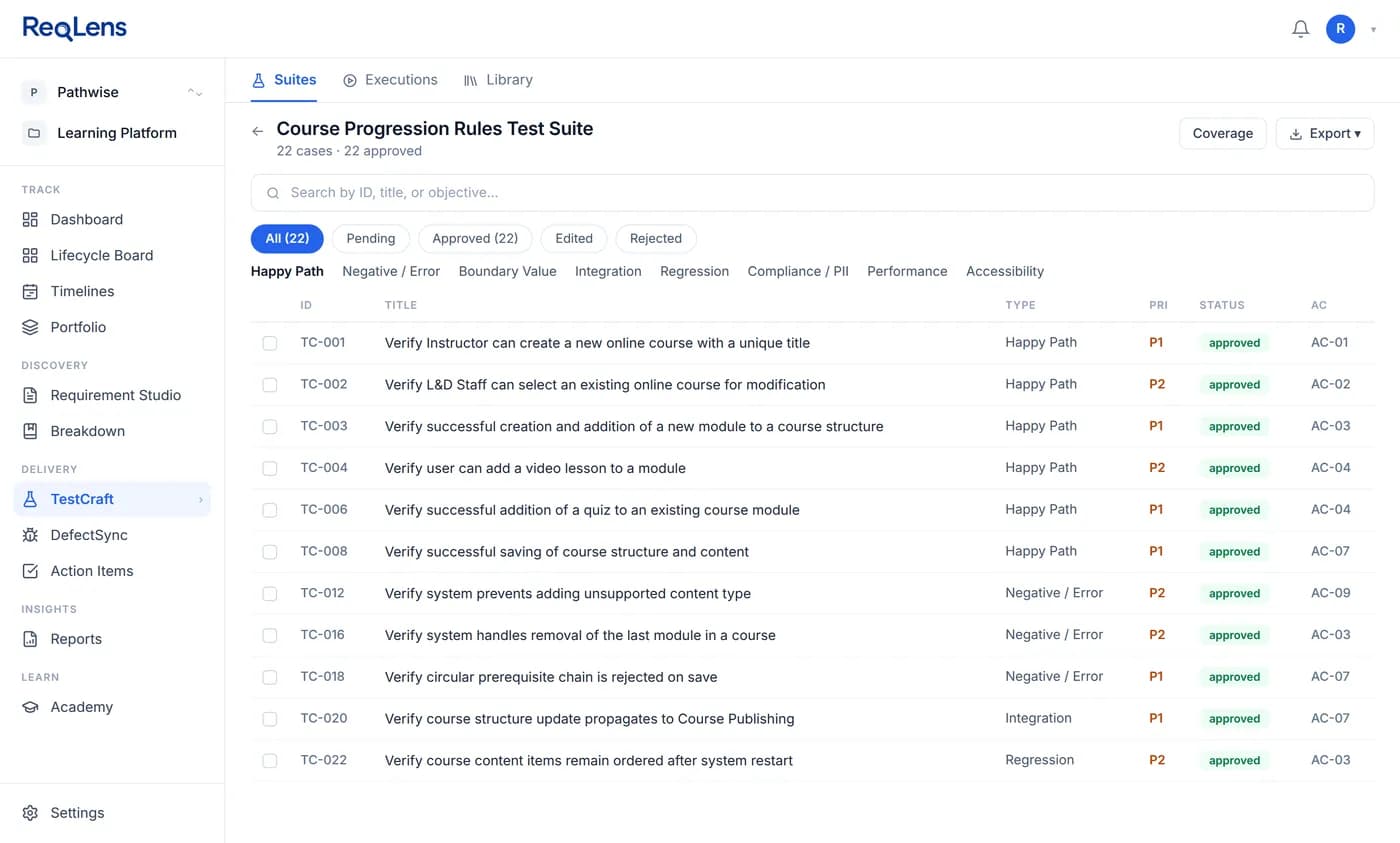
AI test case generation across happy path, negative, boundary value, integration, regression, compliance, performance and accessibility, with test data generated alongside the steps. Look at the right hand column: every case carries the acceptance criterion it verifies. That column is the whole argument. Test coverage stops being a number somebody asserts in a status meeting and becomes a query you can run: which criteria have cases, which do not, and which cases lost their criterion when the requirement changed.
05TestCraft · Executions
Run it. Keep the evidence attached.
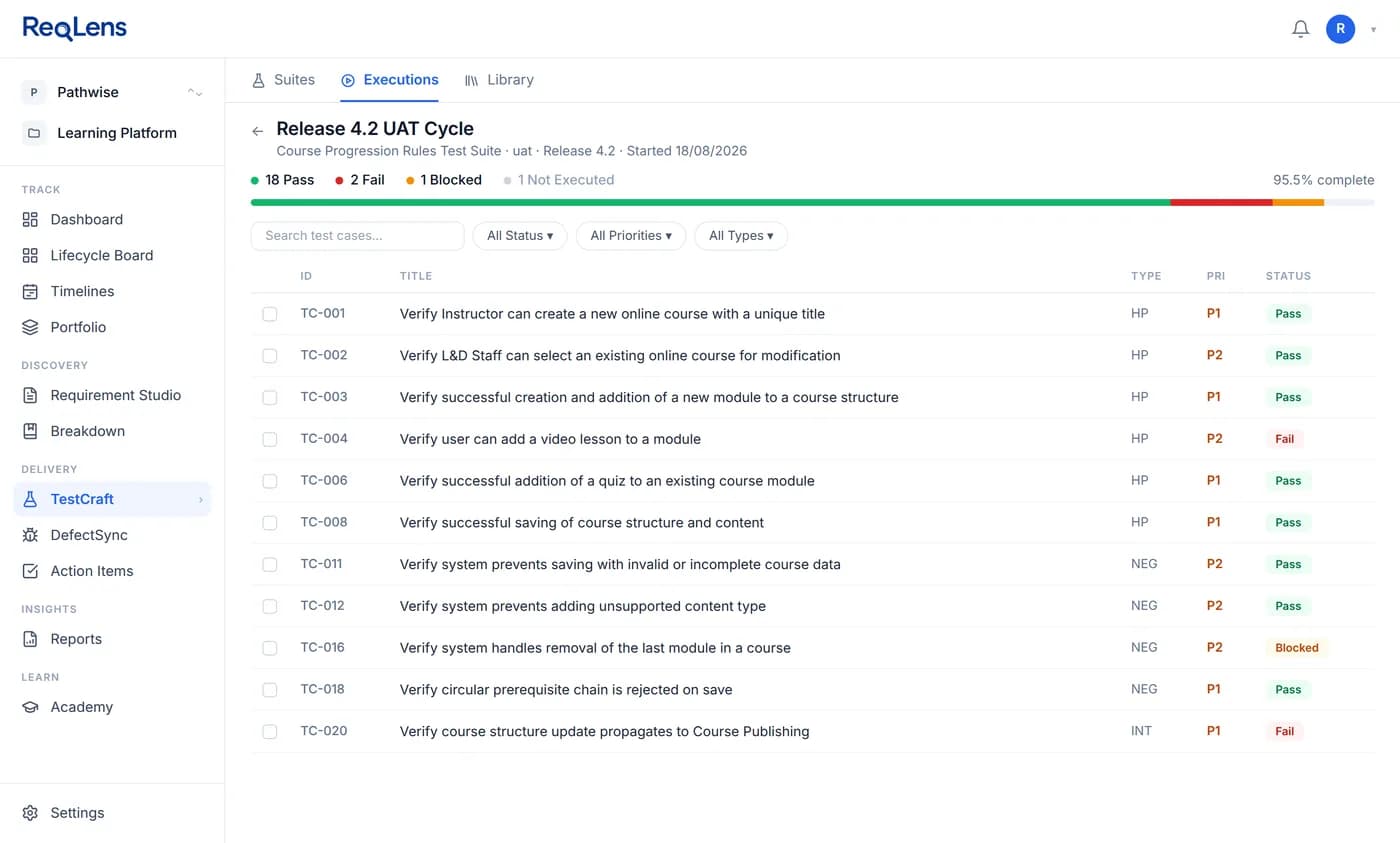
Execute the cycle, record pass, fail or blocked, and attach evidence per case. The run stays queryable afterwards, so what passed, what failed and when is a lookup rather than an archaeology exercise. Coverage and readiness update as results land, which means the release picture is current on any day you ask rather than assembled the week before the gate.
06DefectSync
A failed case becomes a defect that remembers where it came from.
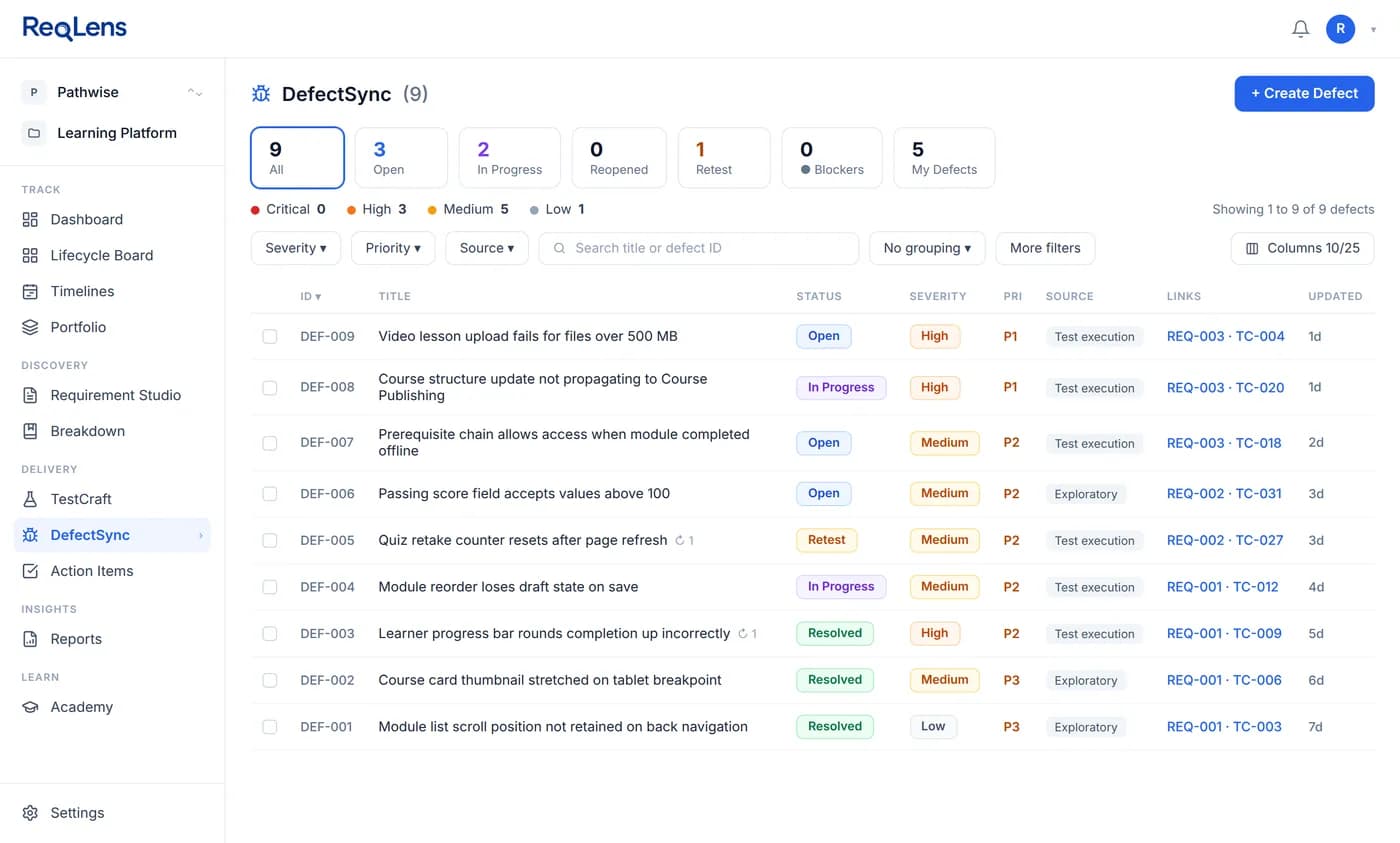
Look at the links column. Every defect carries the requirement and the exact test case that produced it. That link is what closes the gap most teams paper over: the defect marked resolved that nobody ever re-executed. When the fix arrives, ReqLens retests the case that failed rather than asking someone to remember which one it was.
07Reports
Answer the only question that matters at the end.
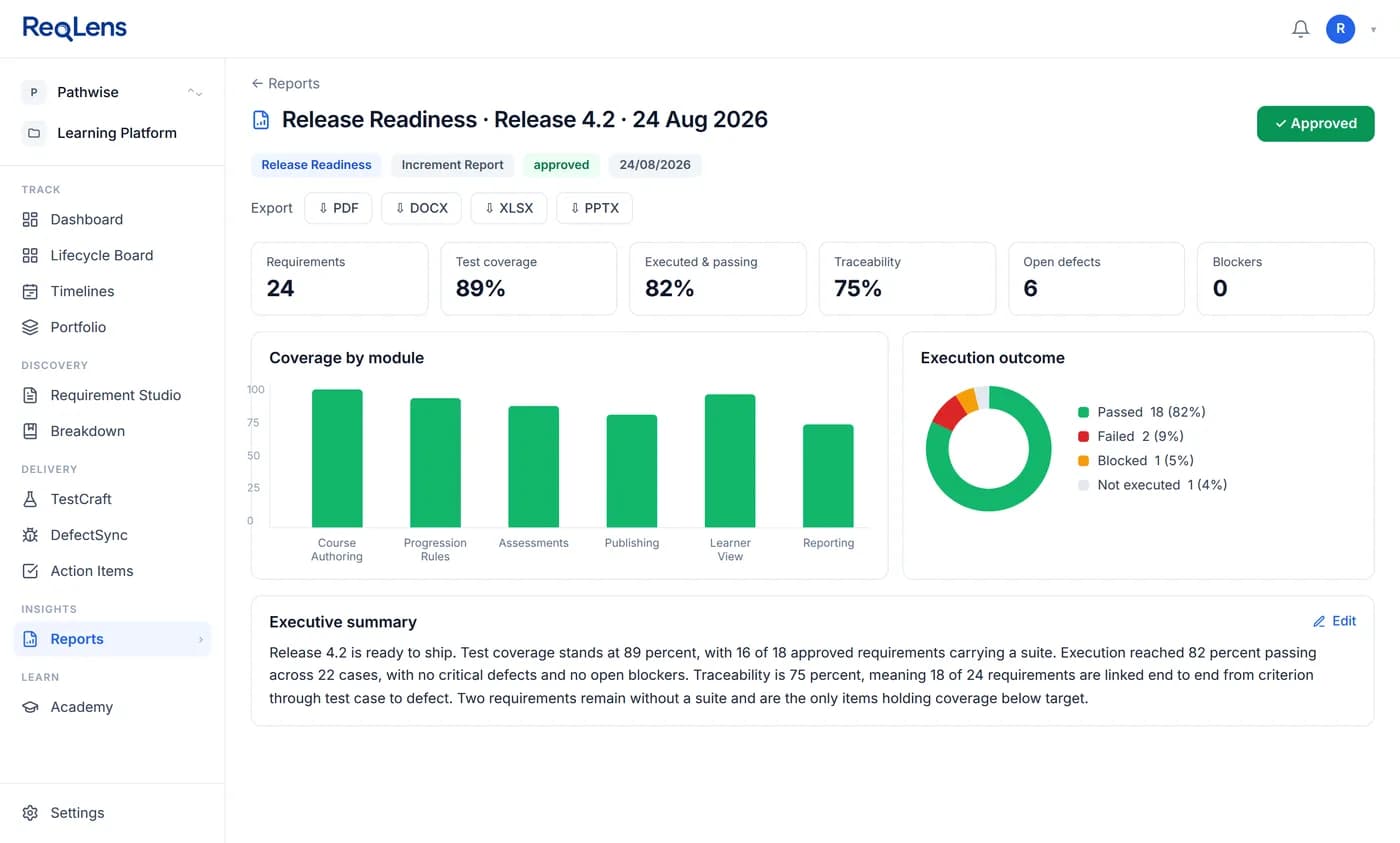
Is this ready to ship, and can we prove it. Test coverage, execution outcome, open defects by severity and traceability across the whole chain, in one report you can approve and export to PDF, Word, Excel or PowerPoint. For regulated delivery this is the difference between a release decision and a release argument: the requirements traceability matrix is not assembled the week before the gate, it has been accumulating since the first requirement was pasted in.